
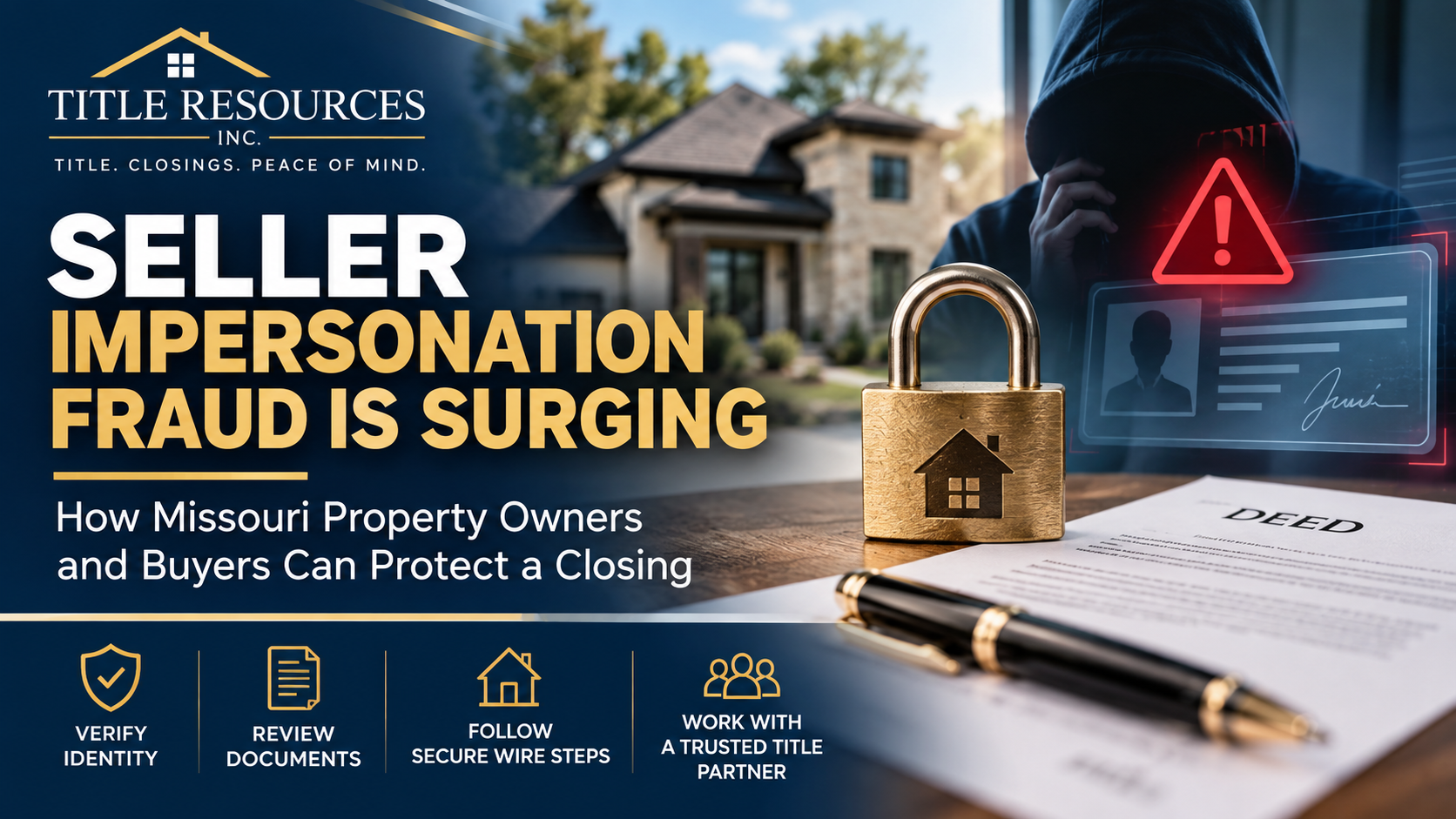
Quick answer: Seller impersonation fraud is becoming a much bigger threat to real estate transactions. New 2026 research from the American Land Title Association found that 59% of surveyed title firms experienced at least one seller impersonation fraud attempt in the prior calendar year, up from 28% in ALTA's 2024 study. Vacant land remains the most common target, but absentee-owned homes, rental properties, properties owned free and clear, and properties connected to recently deceased owners are also attracting fraud attempts.
For Missouri buyers, sellers, Realtors, lenders and investors, the lesson is straightforward: identity verification and careful title work are now essential parts of protecting a closing, not just administrative steps.
What is seller impersonation fraud?
Seller impersonation fraud occurs when a criminal pretends to be the legal owner of real estate and attempts to sell or transfer property without the true owner's knowledge or authorization.
The fraudster may research public property records, create convincing identification, spoof phone numbers or email addresses, and communicate with real estate professionals as though they were the owner. The goal is typically to complete the transaction and redirect the seller's proceeds before anyone discovers the deception.
How common is seller impersonation fraud in 2026?
ALTA's 2026 Seller Impersonation Fraud Study surveyed 245 title insurance professionals across 40 states, the District of Columbia and the U.S. Virgin Islands. Fifty-nine percent of firms reported at least one seller impersonation attempt during the prior calendar year, compared with 28% in ALTA's 2024 study.
The frequency also increased. ALTA reported that 45% of firms experienced at least one attempt in the month before the 2026 survey, compared with 19% in the comparable period two years earlier.
The financial consequences can be significant. Among firms that experienced an attempted scheme, one in four reported a paid claim related to seller impersonation fraud. Of firms that disclosed average claim costs, half reported costs above $100,000.
Which properties are most likely to be targeted?
Vacant land remains the leading target. ALTA's 2026 study found that 82% of respondents identified vacant land as a frequent characteristic in attempted schemes.
But fraudsters are expanding beyond vacant lots. The study also identified vacation homes, rental properties, agricultural land and primary residences as targets. Absentee-owned properties and properties owned free and clear of a mortgage were common characteristics, as were properties associated with recently deceased owners.
These properties can be attractive to criminals because there may be fewer people physically present at the property and fewer routine contacts that could expose the impersonation.
What are the warning signs of a fake seller?
No single red flag proves fraud, but several warning signs together should trigger additional verification.
- A seller insists on communicating only by email or text and avoids telephone or video conversations.
- The property is vacant, a rental, investment property or otherwise non-owner occupied.
- The property has no mortgage or other obvious lien.
- The seller wants a very fast transaction or appears unusually unconcerned about price.
- The seller requests a mail-away signing or insists on choosing an unfamiliar notary.
- Contact information does not match information independently associated with the property owner.
- The seller asks that proceeds be wired to an account that raises questions or changes wiring instructions late in the transaction.
- Identification or signatures appear inconsistent with other available records.
ALTA's 2026 research also found that spoofed contact information is common in attempted fraud, and respondents increasingly reported concerns involving deepfake image or voice technology.
How can title companies help detect seller impersonation?
Title and settlement professionals sit at a critical point in the transaction because they examine ownership, coordinate documents, verify signing authority and handle closing funds.
ALTA found that 94% of surveyed firms use multiple fraud-detection tools they consider helpful, averaging 5.3 tools per firm. Identity verification, direct seller contact and multifactor authentication were among the highest-rated defenses.
Layered verification matters because sophisticated criminals may possess genuine personal information about the property owner. A driver's license or Social Security number by itself may no longer be enough to establish that the person communicating with the closing team is actually the owner.
How can Missouri property owners protect themselves?
Owners of vacant land, rental properties, second homes and properties without mortgages should pay particular attention to unexpected activity involving their real estate.
Keep contact information current, monitor property records when practical, protect personal information, and investigate unexpected calls or messages about a property sale. If a Realtor, title company or other professional contacts you about a transaction you did not authorize, respond immediately using independently verified contact information.
Owners should also be cautious about publicly available information. Criminals can combine property records, social media and other sources to build a convincing profile of an owner.
What should buyers and Realtors do?
Buyers and agents should not assume that a person who appears to know details about a property is necessarily the owner. Many details about real estate and ownership can be found through public or commercial databases.
When a transaction involves vacant land, an absentee owner, an unusually fast cash sale or other risk factors, expect the title company to perform additional verification. Those extra steps are designed to protect the buyer, the true property owner and everyone involved in the transaction.
Realtors can also help by involving the title company early rather than waiting until shortly before closing. Early title work gives the closing team more time to confirm ownership, identify liens and investigate inconsistencies.
What should real estate investors know?
Investors frequently buy vacant land, rental properties and distressed assets, which means they may encounter transactions that fit common fraud profiles.
A deal that appears unusually easy should not bypass normal verification. Investors should be especially cautious when an alleged owner wants to sell substantially below market value, refuses direct contact or pressures the parties to close immediately.
Speed matters in investment transactions, but speed should come from an efficient process, not from eliminating safeguards.
Does title insurance protect against seller impersonation fraud?
Title insurance protects against covered title risks according to the specific policy and endorsements issued. Coverage depends on the policy form, facts of the claim, exclusions, exceptions and any applicable endorsements.
The title industry's primary objective is to identify and prevent a fraudulent transfer before it occurs. ALTA has also developed resources and endorsements addressing certain deed fraud, forgery and seller impersonation risks. Buyers and existing owners should ask their title professional what coverage is available for their particular transaction rather than assuming every fraud scenario is automatically covered.
Why direct verification matters in the age of AI
Fraud technology is evolving quickly. ALTA's 2026 research found that 58% of respondents considered deepfake image or voice technology at least somewhat common in seller impersonation attempts.
That makes independent verification increasingly important. A convincing email, photograph, voice call or even video appearance should not replace established identity-verification procedures.
Technology can help detect fraud, but experienced title professionals and disciplined closing procedures remain essential.
Frequently asked questions
What is seller impersonation fraud in real estate?
It is a scheme in which a criminal pretends to be the legal owner of property and attempts to sell or transfer it without the true owner's authorization.
What type of property is most often targeted?
Vacant land remains the most commonly reported target, but rental properties, vacation homes, agricultural land and primary residences can also be targeted. Absentee-owned and free-and-clear properties are common risk characteristics.
Why are properties without mortgages attractive to fraudsters?
A property without a mortgage may involve fewer third parties with an existing relationship to the legitimate owner. That can make an impersonation attempt easier to execute, although any property can potentially be targeted.
Can AI be used in seller impersonation fraud?
Yes. Fraudsters can use technology to create fake identification, manipulate communications and potentially use deepfake voice or image technology. This is one reason layered identity verification is increasingly important.
What should I do if someone is trying to sell my property without permission?
Contact the title company, real estate professionals and appropriate law enforcement immediately. You may also need legal counsel and should investigate whether fraudulent documents have already been recorded.
Protect the transaction before closing
Seller impersonation fraud is evolving, but careful title work, identity verification and direct communication can make fraudulent transactions much harder to complete.
Title Resources Inc. works with buyers, sellers, Realtors, lenders and investors throughout the title and closing process. To learn more, visit TitleResourcesInc.com.
Ready to order title work? Email orders@titleresourcesinc.com.
Sources
American Land Title Association, 2026 Seller Impersonation Fraud Study and September 2026 research release. FBI Internet Crime Complaint Center guidance regarding vacant-land seller impersonation scams.
This article is for general informational purposes and does not constitute legal advice. Fraud risks and title insurance coverage depend on the facts of the transaction and the policy issued.


